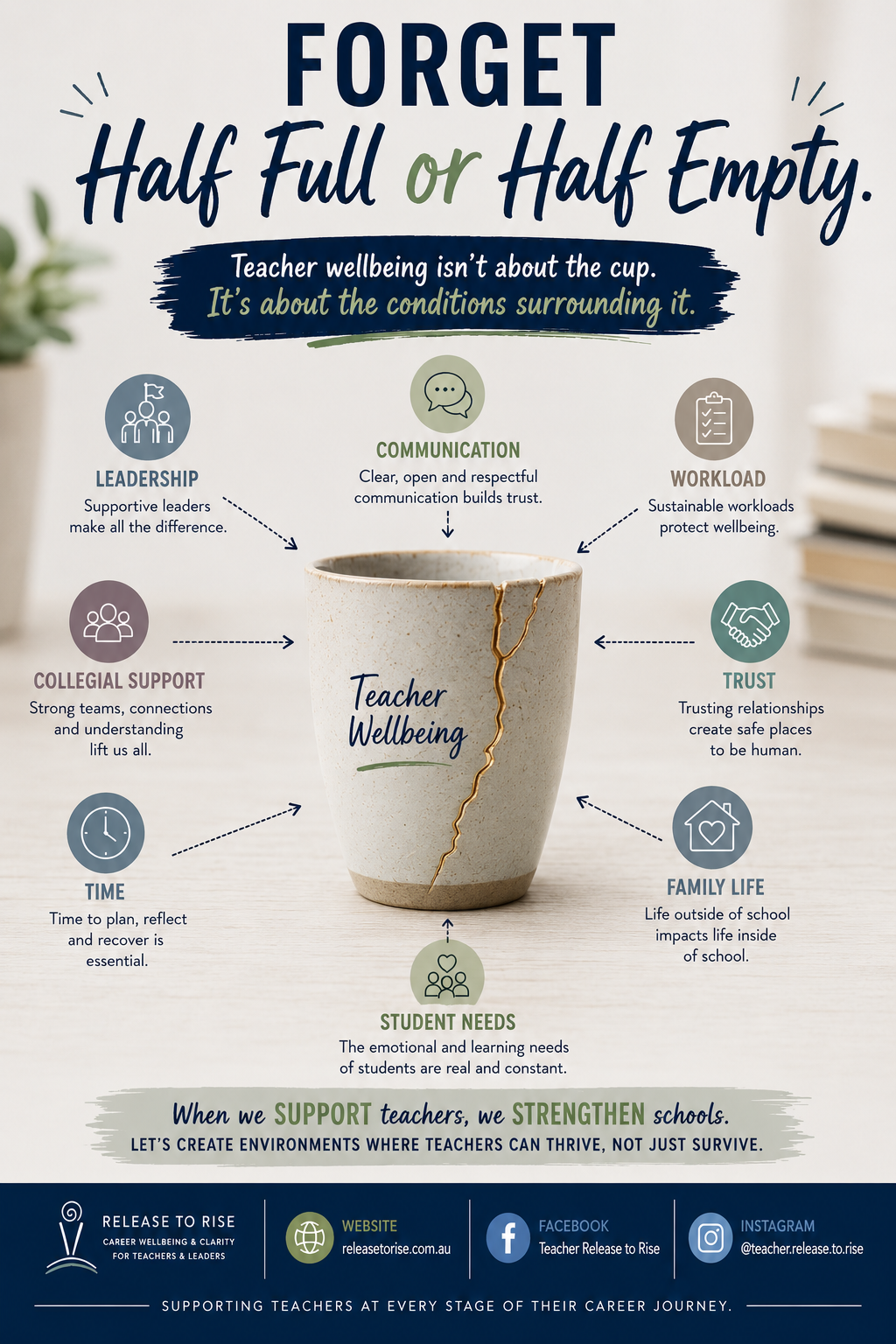
We've all heard the wellbeing analogy before. Is your cup half full or half empty? For years it has been used to encourage positive thinking and personal responsibility. While I understand the intention, I think we've moved far beyond that conversation when it comes to teacher wellbeing.
The real question isn't whether my cup is half full or half empty.
The real questions are: Who is filling my cup? What shape is my cup? Has it been looked after? Is it cracked? Is it sitting in an environment that allows it to stay full, or one that constantly drains it?
Teacher wellbeing doesn't exist in a vacuum. It is shaped by workload, leadership, communication, relationships, trust, support, family circumstances and the culture of the workplace. Two teachers can have exactly the same job, yet experience completely different levels of wellbeing based on the environment around them.
As educators, we are incredibly good at recognising when students need support. We use Zones of Regulation, wellbeing check ins, behaviour support plans and learning adjustments. We know that if a child is struggling, there is usually something sitting underneath the behaviour. We ask questions. We provide support. We adjust expectations.
Yet somehow when it comes to teachers, we often default to telling them to be more resilient, practise self care, take a walk or fill their own cup.
Imagine if teacher wellbeing became a standing item at every staff meeting. Not another survey. Not another compliance task. Just a genuine moment to check in as human beings.
Imagine if we knew that the colleague sitting next to us was surviving on three hours sleep because they have a newborn at home. Imagine if a teacher caring for an elderly parent felt comfortable enough to say they were struggling. Imagine if a staff member could simply say, "I'm not travelling that well this week," and be met with support rather than judgement.
What if schools became places where people genuinely understood what was happening in each other's lives?
Maybe that teacher gets a duty covered. Maybe someone offers to help with a task. Maybe expectations are adjusted for a short period. Maybe nothing practical changes at all, except that person feels seen, understood and valued.
That is what collegiality looks like.
The irony is that we spend our days teaching young people to identify their emotions, recognise their needs and ask for support, yet many adults in schools don't feel safe doing exactly the same thing.
Teacher wellbeing is not about whether your cup is half full or half empty. It is about understanding the conditions that fill it, the things that drain it, and the people who help maintain it. It is about recognising that wellbeing is not solely an individual responsibility. It belongs to all of us.
Perhaps it is time we stopped asking teachers how full their cup is and started asking what they need to keep it full.