
There’s a reason so many teachers say they feel “on edge”, exhausted, emotionally flat, or like they’re constantly carrying too much. For a long time, many of us thought this was just part of the job. Push through. Keep going. Hold it together for everyone else.
But what if some of what we experience in education is actually our nervous system trying to protect us?
Understanding concepts like hyperarousal, hypoarousal, and the window of tolerance can completely change the way we see ourselves, our colleagues, and our students.
When teachers are in hyperarousal, they are often in fight, flight, or fawn mode. This can look like irritability, overthinking, emotional reactivity, people pleasing, difficulty switching off, or constantly feeling “on alert”. Many teachers sit in this state for far too long because schools are busy environments with high emotional demand, constant interruptions, behaviour challenges, deadlines, and pressure to hold everything together.
On the other side is hypoarousal. This is the shut down state. Teachers here can feel emotionally flat, disconnected, exhausted, numb, hopeless, or mentally checked out. It is often mistaken for laziness or disengagement, when in reality it can be a nervous system that has simply run out of capacity.
In the middle sits the window of tolerance. This is the space where we feel more grounded, connected, reflective, flexible, and able to respond rather than react. It does not mean life is perfect or stress free. It means our nervous system feels safe enough to think clearly, connect with others, and cope with challenge without becoming overwhelmed.
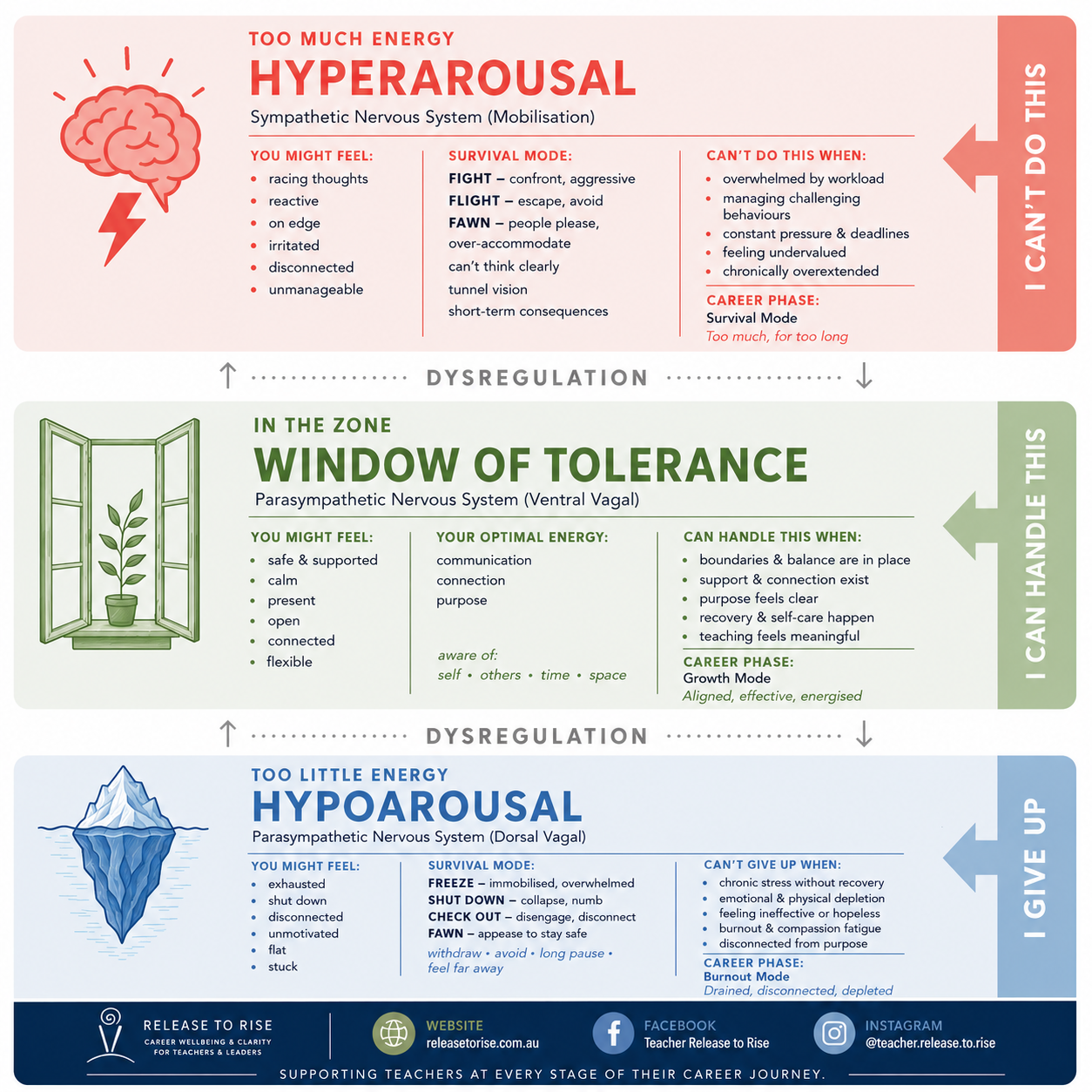
Understanding the Teacher Nervous System and the Window of Tolerance through the lens of teacher wellbeing, burnout, and career sustainability. This infographic explores hyperarousal, hypoarousal, fight, flight, freeze, fawn, and regulation in education, helping teachers and school leaders recognise stress responses in themselves, their colleagues, and their students. Created by Release to Rise, supporting teacher wellbeing, career clarity, and sustainable education practice across Australia.
This matters deeply in education.
As teachers, we are constantly reading the emotional states of students, but many of us have never been taught to recognise our own. When staff are dysregulated for long periods, teams can become reactive, conflict increases, communication breaks down, and burnout spreads quietly through a school culture.
Understanding nervous system states is not about blaming teachers or suggesting everyone simply “self care” their way out of stress. It is about awareness. It gives language to experiences many educators have silently carried for years.
It also helps us lead and support each other differently.
A colleague who is snappy may actually be overwhelmed. A withdrawn team member may not be disengaged, but depleted. A teacher who constantly overfunctions and says yes to everything may actually be operating from a fawn response and struggling with boundaries.
The more we understand these states, the more compassion, reflection, and healthier conversations we can bring into schools.
Supporting teacher wellbeing is not separate from supporting students. Regulated adults create safer, calmer, and more connected learning environments. When teachers understand their nervous system, they are often better able to support both themselves and the young people in front of them.
And perhaps most importantly, it reminds teachers of something many have forgotten:
You are not failing. Your nervous system may simply be asking for support.
